

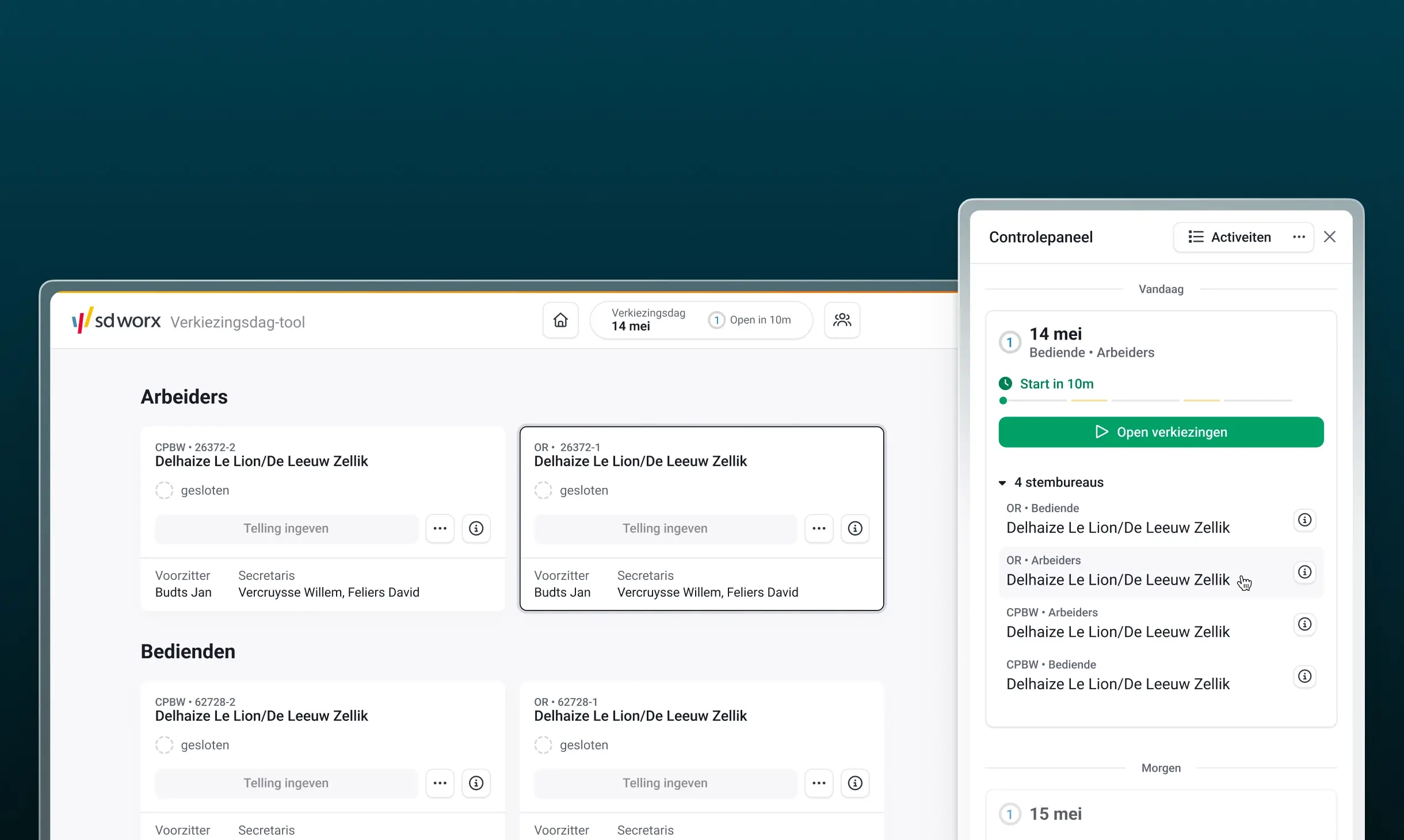
Every four years, thousands of Belgian companies organise social elections. For employers, this is a tightly regulated process, governed by fixed deadlines and strict legal requirements. SD Worx supports companies with their social elections through a digital platform developed together with Teal Partners.
We spoke to Tom Desloovere, Team Manager Legal Payroll Advice & Social Elections at SD Worx, about ten years of collaboration, the complexity of social elections, and the power of technology that makes legal rules workable in practice.

Tom Desloovere: “It is a very meticulous process. In the beginning, the main challenge is timing: every mandatory step in the election process has to take place at exactly the right moment. Later in the procedure, the challenge becomes more practical: just as in political elections, there are summons letters, ballot papers, electoral rolls and election days.
The rules are complex. At specific moments, a company has to take specific actions, such as posting documents, processing lists of candidates and issuing summons letters. Employees have to be correctly classified as blue-collar workers, white-collar employees or managerial staff, because their category determines which list they appear on, which electoral college they vote in and how mandates are allocated.
For our clients, that is a tense process. They have to summon their employees correctly and allow them to vote under the right conditions. It is important that they can trust that everything is legally correct and completed within the statutory deadlines. The tool ensures that.”
The software translates the legislation on social elections into practice.
“The software translates the legislation on social elections into practice. Everything set out in the law is intelligently embedded in the tool. The procedure is built around the calendar with all mandatory dates. If companies follow the tool, they apply the rules correctly.
You can see what needs to be done and when. There is a system that keeps you alert, including colour coding. Green means the procedure is being followed correctly. If you see red in your calendar, there is an issue that needs to be addressed.”
“There are three major moments, starting with the launch. That is when we collect all the data, upload it and check it. We feed the tool with employee data and build the file.
The second key moment is day X, in early February. That is when companies have to display or distribute the most important information within the organisation. Everything has to be correct, because after that almost nothing can be changed.
The third major moment is election day itself, day Y, in May. That is when everything comes together: distributing ballot papers, electronic voting, processing the results. It involves a great deal of work, with very little margin for error.”
“About twenty per cent of our clients choose the self-service mode, where they use the tool intensively themselves.
Four out of five companies choose the model in which we work together. In that case, our consultants mainly use the tool, while the client gets access to the elements that are relevant to them, such as documents they need to download.
The dashboard shows the timing for each company and ranks our clients according to their election date. Because social elections take place within a period of fourteen days, the consultant can immediately see who comes first.”
“It is important that companies can trust that everything is legally correct and completed within the statutory deadlines.”
“For the 2016 elections, we needed a new tool. Development started two years earlier. That new tool was developed by Teal Partners.
The technology behind the old tool had become outdated. What we have now is technically much more advanced. Originally, the intention was to use the tool three times. We are now heading into the fourth elections with it, together with Teal Partners. That proves the robustness of both the tool and the collaboration.”
“In the past, the client could not see what was happening. It was one-way traffic: SD Worx did the work and provided information to the client. Now, the client has more autonomy and can follow every phase more closely. They download documents themselves and carry out actions. For me, that was the major innovation: it became a place where SD Worx and the client work together.
Thanks to the integration with our payroll systems, we can easily import employee data digitally. Previously, that was done through Excel. That too was a huge step forward.”

“Teal Partners helps us turn a legally complex procedure into a tool that is practical to use. They proactively think along with us about improvements. The developers do not simply programme what we ask for. They know the social elections procedure inside out. That means we can work together to arrive at the best solution. They come up with ideas themselves: ‘I would approach it this way — what do you think?’
If the proposal is legally sound, they develop it. During testing, we then review the solution again from a legal perspective. That interaction is very important. Our skills are complementary.
Social elections are difficult enough as it is. The tool has to make the process easier. That is why Teal Partners also pays a great deal of attention to simplicity and user-friendliness, both for us and for our clients.”
“The developers do not simply programme what we ask for. They know the social elections procedure inside out.”
“A technical issue can have major consequences. You do not want a client to have summoned a thousand employees only to find that voting cannot take place. Social elections are deadline-driven, with peak periods in which many people use the tool at the same time. On election days in particular, everything has to be right.
If something goes wrong, we have to move extremely quickly. Whether the issue lies with us, with the data, with the client or with the tool, there is very little time to put it right. But we have always managed to do so. Teal is always ready to help. It is a stressful period, but it also shows the strength of the collaboration.”
“After every election, we look at what can be improved. That way, we avoid errors becoming embedded in the software. Sometimes, a problem during the procedure calls for a quick intervention. Afterwards, we look at how that solution can be integrated more sustainably. Each time, the tool is adapted, refined and improved. The work does not stop after the election day deadline. That drive for improvement is something we share with Teal Partners.
Every four years, the legislation on social elections changes in any case. The framework usually remains the same, but the changes still have to be incorporated into the tool. A good example is agency workers. In 2016, they did not have voting rights; in 2020, they did under certain conditions.
Because agency workers are not on the client’s payroll, that required a major adjustment to the tool. In 2024, the conditions for agency workers changed again. That is typical of social elections: the law changes, and the technology has to evolve with it.
“We are now heading into the fourth elections with it, together with Teal Partners. That proves the robustness of both the tool and the collaboration.”
The digital aspect has also become much more important in the election process. In the past, employees received their summons letter on paper; today, this is usually done electronically. That option did not exist in 2016, was added in 2020 and was further improved in 2024. Since 2020, there has also been a stronger link with an external e-voting tool: data is imported automatically and results are fed back, allowing the tool to calculate who has been elected.”
“That is still too early to say. The legislature is usually late: sometimes the law is only final when we already have to start the procedure. In the meantime, we improve everything we can, and as soon as the new legislation is known, we pick up the thread together.”


