

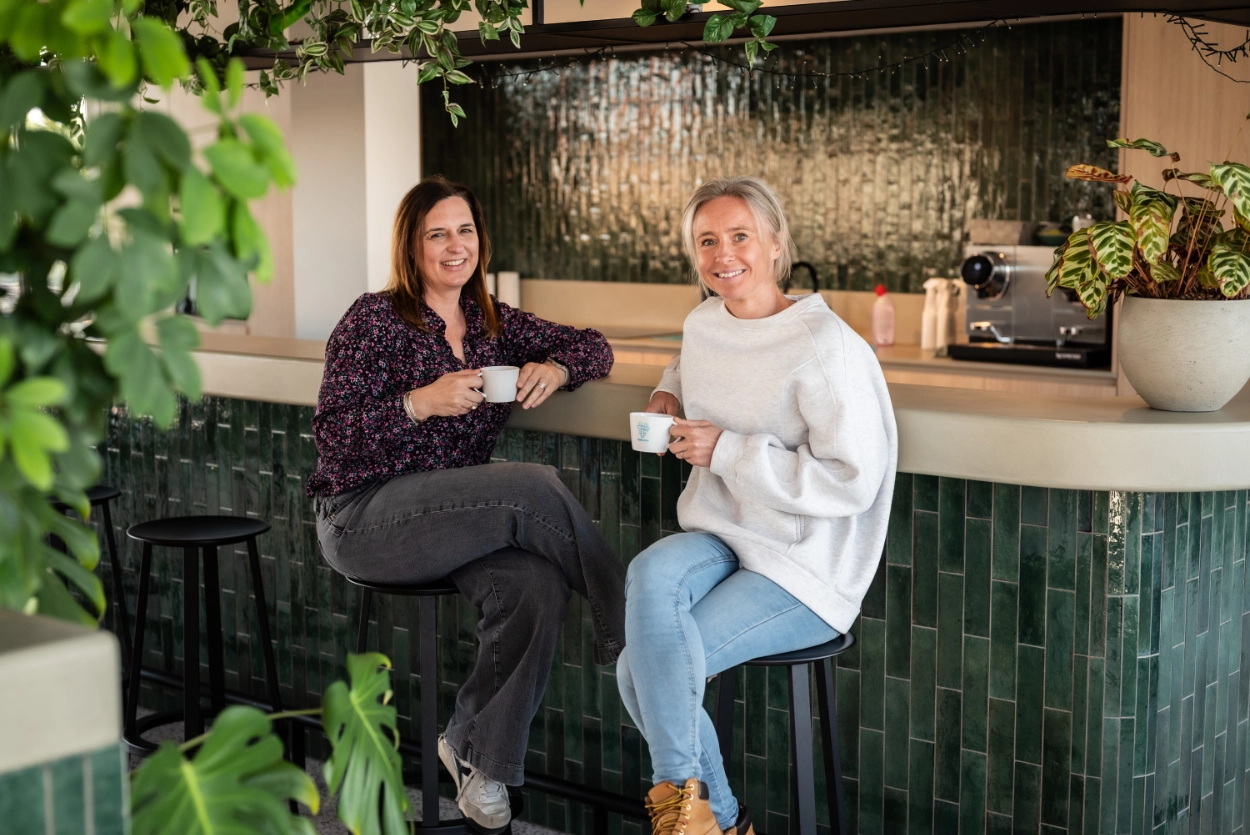
Women are still in the minority in ICT. And yet software benefits enormously from having different backgrounds, ways of thinking and talents at the table. It leads to better products, sharper analyses and stronger teams. On Girls in ICT Day, we are giving the floor to two colleagues who want to inspire women to consider a job in ICT.
Sarah (pictured on the right) works as a developer on Flex Income Plan, SD Worx’s platform for flexible benefits. Digna is an analyst on Buddy, our payroll technology for SD Worx.
Sarah: “Without falling into clichés: there really is such a thing as typically male or female traits. Both men and women have both, but I do think that, on average, women more often bring an empathetic perspective. That connecting side, listening to what someone needs, thinking about how something should work functionally, and then trying to translate that into the technical side: that is incredibly valuable in software development.
Because good software should not only be technically correct. It also has to prove its value and work properly in practice. You always have to ask yourself: how does this help someone move forward? What does the user really need? That perspective is essential.”
Digna: “Balance is important, including gender balance. That is why empowerment matters, so that the balance we have in society is also reflected at company level. It leads to better-functioning teams. We should strive for a good balance, as in everything in life.”
Digna: “The combination of complexity and factual precision. Payroll is about legislation, numbers, logic and systems. That suits me. I get satisfaction from thoroughly figuring something out and then seeing it implemented correctly.
Even in secondary school, I already knew I was good with numbers and facts, but because of my broad interests I still chose the humanities. IT never even crossed my mind. In my day, the positive initiatives aimed at getting more women into STEM fields did not exist yet. A day like Girls in ICT is something I fully support.”
The job you choose should depend only on your interests and talents.
Digna, analist at Buddy
Sarah: “I do hear that sometimes, but my personal experience has been different. For me, it was actually an advantage. As a woman, you do not want opportunities just because you are a woman, but because you are in the minority, you do bring something different to the table. Good companies understand that.
There are developers who are very strong technically. I myself lean more towards the functional and customer-oriented side. In the beginning, I sometimes thought: am I technical enough to keep up? But I have learned that not everyone needs to be highly technical, quite the opposite.
A team lead in a previous job once told me: technical profiles are easier for me to find, but people who talk to the customer, think critically along with them, check whether something actually works, and help make sure everything is tested down to the last detail? They are just as important, and not easy to find.”
Digna: “I think social expectations still play a major role. Why are there still so many women in care professions? As far as I know, there is no science saying that women are worse at technology or that men are unsuited to care work, and yet that imbalance remains. The job you choose should depend only on your interests and talents.”
Sarah: “I agree. I went into software development myself with my father as an example. Boys are still more quickly steered towards technical fields. That is changing, but slowly. When I look at the past fifteen years, I do see a shift, but not a major turnaround yet. These things take time.”
Digna: “It also applies to parental leave or working four-fifths to care for children: it is still mostly women who do that. As a mother, you feel that social pressure. Change is slow. Mentally, we are already much further along than we were thirty years ago, but old patterns are persistent.”
Good software should not only be technically correct. It also has to prove its value and work properly in practice.
Sarah, developer at Flex Income Plan
Digna: “Absolutely. Here, no distinction is made between men and women. What matters is what you contribute. What I appreciate is that there is attention for people without it becoming soft or unnecessarily heavy. Not endless talking for the sake of talking, but support when it is needed. At the same time, the focus remains sharp: substance, quality and progress. That works for me.”
Sarah: “At Teal Partners, we build complex software. In the past, I would have shied away from that word ‘complex’. But with complex software, it is exactly important to have a broad range of talents at the table. Our teams need all kinds of strengths. Analysis, development, testing, support, customer contact: as a developer, you do it all, depending on your strengths. That is why we need different types of developers.”
Sarah: “Do not let it intimidate you. We need you in this profession. Girls or women who think, that technical side is not for me, have nothing to fear. I had doubts myself. It was only later that I realised how important more diversity is in our field.”
Digna: “The same advice I would give boys: if it interests you and it makes you happy, go for it. It should make no difference whether you are a girl choosing technology or a boy who wants to become a nurse. Do not let yourself be guided by what supposedly fits your gender. Focus above all on what gives you energy and where your talents lie.”
Girls in ICT Day, an initiative of the United Nations’ International Telecommunication Union (ITU), aims to encourage girls and young women to explore studies and careers in digital and technical fields. The initiative is part of ITU’s work on digital inclusion for women and girls and is held every year on the fourth Thursday of April.


