

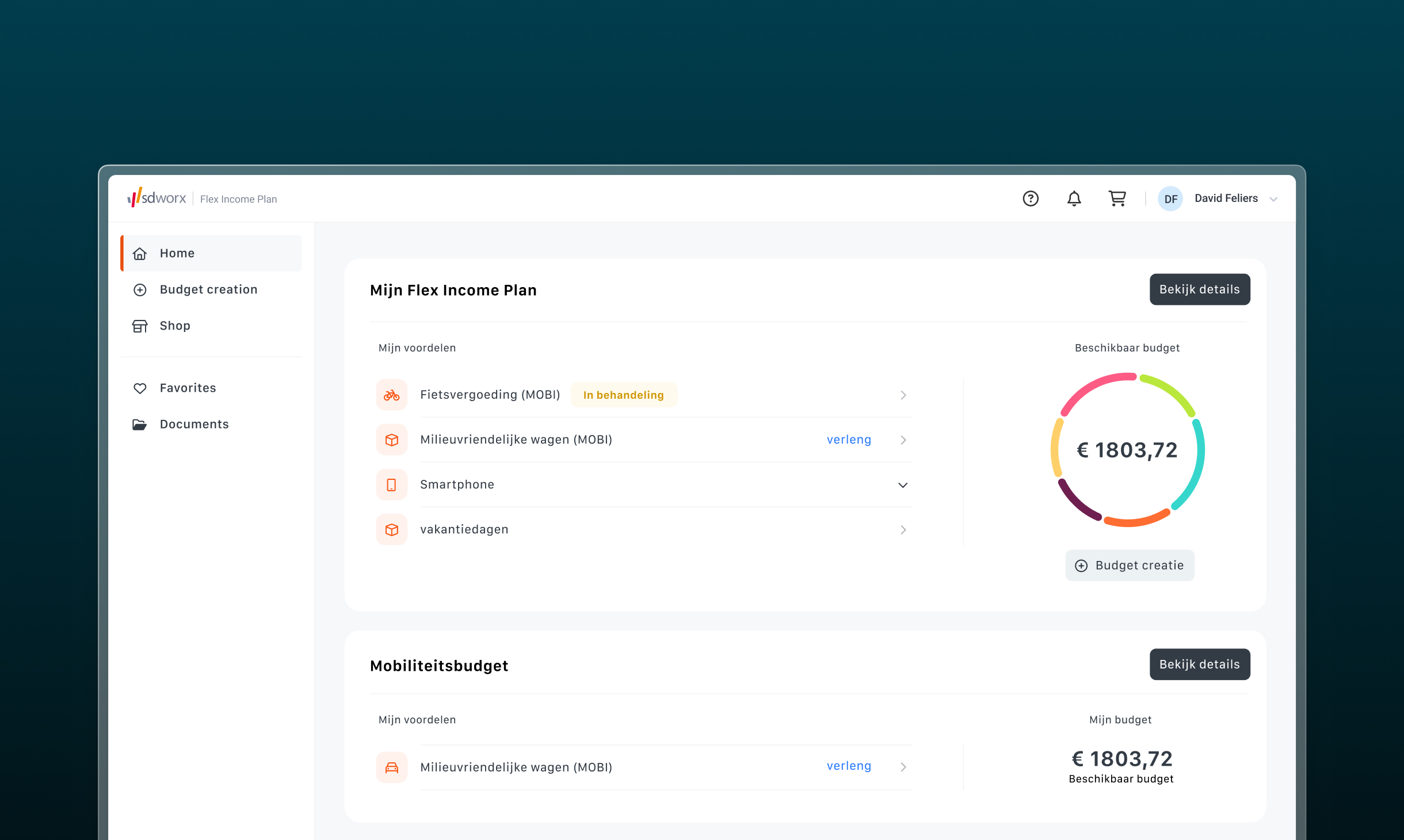
Flexible reward has become increasingly popular in recent years. With Flex Income Plan, SD Worx has long played a pioneering role in that evolution. Together with Teal Partners, SD Worx has developed the platform into the most flexible solution on the market – with the largest number of clients, benefits and integrations. We spoke to Annick De Cock, Business Unit Manager Advisory at SD Worx.
Annick De Cock: “FIP is strategically important to us. It fits perfectly within our digital-first approach: a strong tool, combined with consultancy and expertise. Many systems remain behind the scenes. FIP does not. Our clients’ employees interact with it directly. They choose the benefits that matter most to them. That increases their satisfaction, which also benefits the employer. At the same time, we make sure the whole process remains manageable for the employer.”

Annick De Cock: “Initially, FIP was only for large companies. They had the budgets required to develop the platform. Since then, FIP has evolved into a broad platform. Today, it is also a popular tool among SMEs. Flexible reward is shifting from a nice-to-have to a must-have. Candidates increasingly expect it, and employers are becoming aware of that.”
Annick De Cock: “There are two major strengths. The first is how FIP deals with budgets. In many systems, you work with fixed pots for specific benefits, or with an annual logic in which a budget has to be used up within the year. FIP is much more open. The tool gives employees maximum access to benefits, without making the process unmanageable for the employer.
FIP does not say: your pot for that benefit is empty, bad luck. Instead, the system looks intelligently at different budget sources, at what is legally possible, at recurring or one-off budgets, and at how choices can be spread in the best possible way. As a result, employees can usually do more with their money in our system, without creating financial or administrative problems later on.
The second strength is integration. FIP is connected to payroll. Data from payroll flows correctly into FIP, and employees’ choices flow seamlessly back.
From an innovation for the select few, FIP has grown into a platform at scale.
Alongside the integration with payroll systems, we also offer a broad range of provider integrations. Employees click through from FIP to, for example, a bicycle leasing company or a multimedia provider. What they choose there is correctly fed back into FIP and, from there, into payroll. I sometimes say: FIP is the mothership. You briefly go and buy something from the daughter, but the daughter sends it back to the mothership, so that everything is calculated and processed correctly.
That ecosystem has become very broad. It is not only about mobility and multimedia, but also about wellbeing, learning, financial reimbursements and the mobility budget. That broad scope is a real strength.”
Annick De Cock: “Under the bonnet, it is complex, but on the user-facing side we aim for simplicity and ease of use. FIP is complex to programme because it contains a great deal of legal, fiscal and technical logic.
Some benefits, for example, can be financed from different budget sources, while others are legally restricted. The tool constantly makes intelligent assessments: what is possible, what is allowed, what is best for that employee, and what is conclusive for the employer? That is not a simple calculation. It requires a powerful engine that can continuously handle numerous calculations.
In addition, the legal and sectoral framework is complex. Not every company can offer the same level of flexibility to every group of employees, because it depends on legislation. That is difficult for companies – what is possible for one company, or for one group of employees, may not be allowed for another. At the same time, we are seeing more and more flexibility being introduced.”
Annick De Cock: “Scale. In the past, FIP was something for the select few. Today, we have hundreds of thousands of users. That is fantastic, but it changes everything. In the beginning, it was all about innovation: does the concept work, is the functionality right, can we build something new? But because of the enormous growth, the importance of stability, performance, release management and security has increased exponentially. If something goes wrong, the impact is much greater.
Flexible reward is shifting from a nice-to-have to a must-have. Candidates increasingly expect it, and employers are becoming aware of that.
Speed and innovation remain important, but you have to build in many more checks and deal with releases, escalations and monitoring in a much more professional way. Teal Partners has grown with us perfectly in that respect. They had already proven themselves as pioneers, but they are also there in this phase of scale and professionalisation.”
Annick De Cock: “The larger the platform becomes, the greater the responsibility. In an environment where payroll and personal data come together, security has to be at the highest level.
When security works well, it is invisible. But behind the scenes, it requires an enormous amount of work: monitoring, layers of protection, follow-up, testing. From the very beginning, Teal Partners has had that firmly under control, and that is something I greatly respect.”
Annick De Cock: “We work with the Teal team as if they were our own colleagues. They are always willing to think things through with us: how are we going to solve this, what is really needed here, what solution makes sense in the long term? They do not only think technically, but also conceptually and from the client’s perspective.
I also appreciate the fact that they challenge us. Sometimes a client asks for something, but that is not necessarily the best solution. In those moments, it is valuable to have a partner at the table who goes back to the core and helps us think about what is really needed and what will work best to achieve that goal.”
Annick De Cock: “Through the combination of commitment and common sense. Domain knowledge is, of course, essential, and they have that. But what I find at least as important is that Teal Partners thinks along with us about the best solution, without building something that looks impressive on paper but later becomes impossible to maintain.
You always have to find the balance between innovation and stability. If you build something that no one can maintain any more, you are not helping your client.
FIP used to be something for the select few. Today, we have hundreds of thousands of users. That is fantastic, but it changes everything.
Teal Partners thinks along, challenges us and really gets inside our heads. They do not simply execute; they want to understand the real needs. They grow with a product: from the pioneering phase to scale, stability and further professionalisation. For me, that is their major added value.”
Annick De Cock: “For development, we work with a fixed sprint rhythm. In addition, there are operational meetings where we look together at how to approach specific issues. On a quarterly basis, there is the overarching product meeting. And for specific projects, we also organise separate brainstorms.
What I find important is that we work in small iterations. So we do not spend too long developing without validating things, but regularly show, discuss and adjust. That way, we avoid ending up with something that may be technically impressive, but unnecessary from a business perspective.”
Teal Partners grows with a product: from the pioneering phase to scale, stability and further professionalisation.
Annick De Cock: “We want to further automate onboarding, including within the mobility budget. Our goal is to allow clients to activate much more themselves via a wizard. That is necessary to achieve the scale we have in mind.
Performance is an important theme. With more users on the platform at the same time, everything obviously has to remain stable.
We also want to go further in how the tool guides employees. Historically, FIP has grown strongly as a calculation tool and integration platform, but at the front end it can still do more. Think of targeted communication to users: alerting employees at the right moment to benefits that are relevant to them, or informing them better about the choices they can make. There is still a great deal of potential there.”


